
As I write this newsletter a major flareup of violence is taking place in Israel and Gaza. There has been indiscriminate rocket fire from Gaza into Israel. Hundreds and hundreds of Israeli civilians have been brutally killed or kidnapped in clear disregard for human rights by Hamas and Islamic Jihad. Israeli’s doctrine of “disproportionate retaliation” is now being applied with bombing and shelling of parts of Gaza. A massive act of collective punishment is underway. Inevitably many more people will be killed, injured, and made homeless. There is no possible military solution to this continuing tragedy. The root causes of injustice that lead to despair, hopelessness, and alienation must be addressed if there is to be any hope of a peaceful future for both Israelis and Palestinians.
In the declaration of independence prior to the establishment of Israel in 1948, it was promised that Israel would, “ensure complete equality of social and political rights to all its inhabitants irrespective of religion, race, or sex…” It was also promised that Israel would, “guarantee freedom of religion, conscience, language, education, and culture; it will safeguard the Holy Places of all religions; and it will be faithful to the principles of the charter of the United Nations.” This declaration has never been formally adopted by Israel which has always favoured one group (Jewish Israelis) based on religious and national identity, at the expense of another group, Palestinians (Muslim and Christian). So long as this continues the conditions for violence will flourish and prospects for peace will be denied. As we know from Irish history, the systematic suppression of one group by another inevitably leads to violence.
It is increasingly recognised by human rights organisations that Israel is an apartheid state. Treating people differently based on racial and national identity generates resentment and anger. Peace will only come to this troubled region when there is an end to racial discrimination; an end to the occupation of Palestinian land; and equal treatment for all the people who live between the Mediterranean Sea and the Jordan River. In 1994 it was my privilege to observe the elections that brought an end to apartheid in South Africa. It would be wonderful to see an end to the apartheid regime in Israel, which is the cause of so much suffering for Palestinians and Israelis.
Violence and diplomacy
This summer has seen an increase of violence in the Occupied Palestinian Territories with several raids by the Israeli army into Palestinian cities; the killing of Palestinians by Israelis and of Israelis by Palestinians; and violent “revenge” attacks on Palestinian communities by the more extreme elements of the illegal settlers.
Foreign Minister, Micheál Martin visited Israel, Palestine, and Jordan at the beginning of September with the intention of reviving negotiations and promoting the EU policy of a two-state solution. Sadly, with the intransigent attitude of the current far-right Israeli administration, there is little prospect of any resolution of the conflict. A newspaper article (IT 06/09/23) points out that “According to statistics from the United Nations Office for the Coordination of Humanitarian Affairs (OCHA), 174 Palestinians were killed by Israelis in the first half of 2023, two and a half times higher than the same period last year. Twenty-four Israelis, including six children, were killed in Palestinian attacks during the same period.“
The United Nations office for the Coordination of Humanitarian affairs compile accurate statistics of attacks, injuries, and killings. The linked OCHA Protection of Civilians report, 8-21 August, gives a snapshot of the grim toll on human lives and livelihoods. It notes the demolition of homes, a school and animal shelters in addition to the personal injuries. Another UNOCHA report focuses on settler violence against Palestinians. As the occupying force the Israelis have a legal obligation to protect Palestinian civilians but sadly Israeli soldiers typically allow the settlers to attack Palestinians and sometimes actively join in the assaults.
Given this increase in violence the question must be asked: what is the point of diplomacy when the Israeli government is committed to more settlement building and land confiscation? Instead of waiting for a united EU position Ireland could take a positive lead by taking several steps:
- Recognising Palestine – a Dail mandate is in place for this
- Enacting the Occupied Territories Bill to ban trade with the illegal settlement – a Dail mandate is in place for this
- Call for the reformation of the UN committee on apartheid
Is “Apartheid” an unhelpful word?
Whilst visiting the Middle East Micheál Martin restated his view that it is “unhelpful” to use the word “apartheid” in relation to Israel. However, there is an increasing acceptance by human rights organisations that the Israeli system of discrimination does qualify for the legal definition of apartheid. John Reynolds, associate professor of law at Maynooth University has made the case for reestablishing the Special Committee on Apartheid at the United Nations. Reynolds points out that in 1987 Ireland was the first country to ban the importation of produce from apartheid South Africa. Ireland is well placed to play a similar leading role in the case of Israel. Waiting for countries such as Germany and Hungary to reach an EU position on action against Israel is a recipe for no action at all. Ireland should take the lead.
A Damascene conversion
The South African Methodist Minister, Brian Brown, who was banned in apartheid South Africa for his anti-apartheid activities, comments on the change of heart by the Jewish South African, Benjamin Pogrund, which was reported in the Guardian Newspaper. Pogrund was a journalist and deputy editor of the Rand Daily Mail, which exposed the reality of apartheid policies in South Africa. However, when he settled in Israel in 1997, Pogrund initially denied that apartheid was being practiced by Israel. He now concludes that he is, “witnessing the apartheid with which I grew up in South Africa.”
The response from Brian is lengthy but well worth including here
Benjamin Pogrund and I were schoolboys in Cape Town when in 1948 White South Africa’s first apartheid regime introduced its pernicious policies. As adults, neither of us bought into a political ideology that was fascist, racist, constant in its institutionalised discrimination against Black people, and destructive of democracy. Both of us sought to affirm the moral values espoused by the faiths of Judaism and Christianity and both came to bite the hand that fed White prejudice and privilege. Pogrund became a distinguished journalist and deputy editor of the anti-apartheid newspaper, The Rand Daily Mail. As a Methodist minister I became deputy to The Christian Institute of Southern Africa’s esteemed director and Afrikaner dissident, Dr C F Beyers Naudé. In a society where the ‘liberal’ press could be ambiguous as to the brutality of the regime and its web of deception, the CI relied on those like Pogrund to ‘tell it like it is’. Inevitably, this denunciation of state-evil had painful consequences. The RDM was crippled by censorship, the establishment of a state-funded and compliant rival and the flight of conservative readers made uncomfortable by its truths. It closed in
The CI was banned by the regime, together with its officers, in 1977. My banning was renewed annually for thirteen years due to calls made for Boycott, Disinvestment and Sanctions (BDS) to be implemented against the apartheid regime. Pogrund views BDS as a major reason for the White population coming to give up on apartheid and allow for a non-racial democracy. Fast-forward to more recent times. My erstwhile ally Pogrund having settled in Israel in 1997, he became a redoubtable and state-encouraged opponent of those of us who declared Israel to be replicating the policies of apartheid – notably Jewish colleagues like Joe Slovo, Denis Goldberg and Ronnie Kasrils. As leading figures in Nelson Mandela’s liberation movement they had sacrificed much in opposing the progressive dispossession of the Black ethnic group by the White ethnic group – of nationality, land, human rights and basic freedoms – then prevalent in South Africa. Soon thereafter they would observe this racist ideology of ethnic superiority being replicated against millions of Palestinians by successive Israeli regimes.
The government of Prime Minister Benjamin Netanyahu has ensured that no Palestinian can vote as a national of an internationally recognised state in the territory between the Mediterranean ocean and the Jordan river. Palestinians in the occupied territories have no state to call their own and no Palestinian (Arab-Israeli) living in Israel is regarded as a national of that state for the reason that Israel is a state for Jews alone. As apartheid South Africa was a state for Whites alone. So much for supposed democracy. The suffering resultant upon Israel’s violation of international law over fifty-six years of West Bank occupation, the unyielding blockade and siege of Gaza, and the ‘annexation’ of East Jerusalem intensifies day by day as an ultra-nationalist and ultra-orthodox regime implements with intent its policies of ethnic dispossession.
In my book of 2021, ‘Apartheid South Africa! Apartheid Israel?’ (where the answer to the question is given in the affirmative) I take issue with Pogrund’s robust denial of the State of Israel’s apartheid credentials and his assertion that ‘the differences prevailing still outweigh the similarities’. A significant concession to this was his understanding that putting West Bank Palestinians under the control of the Israeli State, while denying them citizenship, is apartheid. Pogrund saw any Palestinian ‘state’ emerging on such limited terms as akin to South Africa’s Bantustans or homelands; ‘a nonsense state’. Given the assurances that Netanyahu has given to the more than half-million illegal
Jewish settlers in the West Bank as to their assured permanency, allied with their Israeli citizenship, he could have added that even a Palestinian ‘nonsense state’ will never be allowed to emerge. Pogrund’s reappraisal, as carried in The Guardian newspaper, is thus very significant. He does not mince words and his words are chosen with care: ‘I have long rejected claims that Israel is an apartheid state. Now I believe that is where it is heading…the accusation is becoming fact…Israel (is) being driven into inhuman, cruel behaviour beyond any defence…(we) deny Palestinians any hope of freedom or normal lives…1200 West Bank Palestinians are reported to be imprisoned without trial…Settlers kill Palestinians and destroy houses and cars, courts seldom intervene, soldiers stand by and watch…the apartheid label is correct…I am now witnessing the apartheid with which I grew up in South Africa’.
Accusations of antisemitism would be anticipated were I to use Pogrund’s descriptive words of ‘power grabbing, fascism and racism’ when defining the nature of the current Israeli regime. His revised conclusion on comparing the two societies is that the similarities now require him to declare the reality of Israel’s apartheid. He cautions that thought is needed about making these comparisons. That is why many of us who testify to an apartheid Israel distinguish between the ‘petty apartheid’ of enforced segregation, which Israel does not practise, and the ‘grand apartheid’ of ethnic cleansing and dispossession which Israel does practise.
Although this comparative analysis is compelling, Pogrund does not develop the complementary legal analysis which human rights organisations, both in Israel and internationally, use to come to the same conclusion. This surprises. As a long-standing human rights activist he is conversant with the conventions and statutes that define apartheid as a crime against humanity; a crime of which Israel is now guilty.
Pogrund’s concluding references to the dynamics of the call for BDS against Israel disappoints. He understands that protagonists of BDS will use it as a weapon against an apartheid Israel. But does he lament the apartheid policies of his nation essentially because they deny millions of Palestinians freedom, dignity, the right to return home and even life itself, or because they now provide a powerful weapon for those he suggests would destroy Israel? Why demonise a BDS pursuit whose efficacy in promoting non-violent change in South Africa he has acknowledged? In the histories of apartheid South Africa and apartheid Israel one can point to a minority of BDS activists who, in his words, would spread lies about racist regimes either through ignorance and/or malevolence. But his courageous and close engagement with Black liberation leaders in South Africa would have made him aware that their long ignored BDS endeavours were not motivated by desires to destroy either Whites or their State. Rather, the supporters of Mandela, Robert Sobukwe and Steve Biko shared invariably in the pursuit of equality for all and the vision of the indivisibility of freedom. It is nothing less in regard to the ethos of the Palestinian activists who lead their BDS movement today.
(Reverend Brian J Brown, Birmingham, UK. 26 August, 2023.)
Brian Brown’s excellent analysis, “Apartheid South Africa! Apartheid Israel?” Is available at a cost of €15 by writing to John Parkin at kairosireland@gmail.com Post and package, if required, is an additional €10.
A warning by the Elders
In June, Mary Robinson and Ban Ki-moon visited Israel as part of the search by the international Elders Group to encourage a search for a peaceful resolution of the Israel-Palestine conflict. They warn that currently there is a move to a one-state reality where under the provisions of the Nation State Law, “the Jewish people have an exclusive and inalienable right to all the parts of the land of Israel.” The Elders warn that democratic principles are being abandoned in Israel.
“They also saw for themselves some of the facts on the ground, and heard from Israeli, Palestinian, and international human rights organisations about the ever-growing evidence that the situation meets the international definition of apartheid: the expansion and entrenchment of illegal Jewish settlements in the West Bank and East Jerusalem, the establishment of dual legal regimes and separation infrastructure in the Occupied Territories, and the institutionalised discrimination and abuses perpetrated against Palestinians.“
A visit to Ireland by special rapporteur, Francesca Albanese
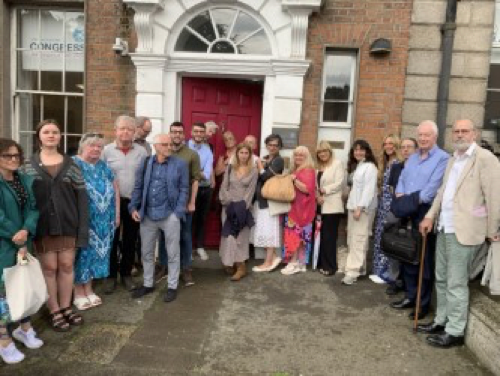
The UN special rapporteur on the Palestinian Territories visited Ireland in June and met with politicians, the Department of Foreign Affairs, and members of the Irish Anti-apartheid Campaign for Palestine. She recently published her second report, which focuses on the systematic incarceration of Palestinians by Israel. Since 1967, when the occupation began, the report states that Israel has imprisoned approximately one million Palestinians including tens of thousands of children. Albanese stated that detention is used to suppress resistance to the colonisation of Palestinian land. She criticised international actors such as the USA, the EU, and the Quartet group for not insisting that Israel should uphold international law. She noted that to date no investigators have been sent from the International Criminal Court to Israel and the Occupied Territories. This is in marked contrast to a speedy reaction by the ICC to human rights abuses by Russia in Ukraine.
A dossier on Israeli apartheid
“A dossier on Israeli apartheid: A Pressing Call to Churches Around the World”, was prepared by the Palestinian Christian organisation Kairos Palestine and by Global Kairos for Justice. The dossier defines the international crime of apartheid as defined by the Rome Statute of the International Criminal Court (2002) and describes how they apply in relation to the deliberately fragmented Palestinian people. The dossier draws together and briefly summarises statements from Israeli, international and Palestinian NGOs condemning Israeli apartheid. It includes a brief theological reflection and points to statements by Church and Jewish bodies, including former Israeli ambassadors condemning Israeli apartheid. Finally, the dossier calls for political, diplomatic, and economic pressure on Israel and an end to impunity for disregarding international law.
“Palestinian Christians” – a recent publication.
Kairos Palestine and the BADIL Resource Centre produced a publication to mark the 75th anniversary of the Nakba entitled, “Palestinian Christians: The Forcible Displacement and Dispossession…Continues.” The publication highlights the pressures on the declining indigenous Palestinian Christian community. A concluding quotation by the Lutheran Academic Mitri Raheb states, “In the 1948 (Nakba) 35 percent of Palestinian Christians living in Palestine lost their possessions, their work, their land, and their homes. The decline of the Christian population was quick and striking in the thriving Palestinian cities. The percentage of Christians in Palestine dropped from around 8 percent to 2.8 percent within just a few months.“
The report lists seven policies used by Israel that negatively affect the Christian community. These include land confiscation (eg around Bethlehem), denial of residency rights, denial of planning permission and the complex permit system controlling movement for work, study or health purposes (there are over 100 different permits).
Palestinian Christian leaders are dismayed that many western Church leaders often ignore the situation facing Palestinian Christians. In December 2021 the Heads of Churches in Jerusalem drew attention to attacks on Christians saying, “Since 2012 there have been countless incidents of physical and verbal assaults against priests and other clergy, attacks on Christian Churches, with holy sites regularly vandalised and desecrated, and ongoing intimidation of local Christians who simply seek to worship freely and go about their daily lives.”
In a list of recommendations, the report writers call on churches throughout the world to –
- Reject theologies and understandings of the Bible that have been used to justify the oppression of Palestinian people
- Support the work of Palestinian churches and church ministries
- Oppose anti-Semitism, racism and xenophobia.
- Come and see the reality in the Holy Land with compassionate eyes…(and)…stand in solidarity with all who work for a just peace.
Three comments from Palestinians voices on the current violence in Israel and Gaza.
They all call for a just peace and a recognition that the terrible violence of recent days comes from 75 years of oppression of the Palestinian people.
- Kairos Palestine represents Orthodox, Catholic and Protestant churches in Jerusalem
Kairos Palestine Statement on the war on Gaza - Sabeel is an ecumenical grassroots liberation theology movement among Palestinian Christians
A Statement from Sabeel Ecumenical Palestinian Liberation Theology Centre - Mitri Raheb is the Founder and President Dar al-Kalima University College of Arts and Culture, Bethlehem. He writes at the conclusion of an international conference that occurred immediately before the current eruption of violence.
A message from Dr Mitri Raheb
Discover more from Kairos Ireland
Subscribe to get the latest posts sent to your email.
